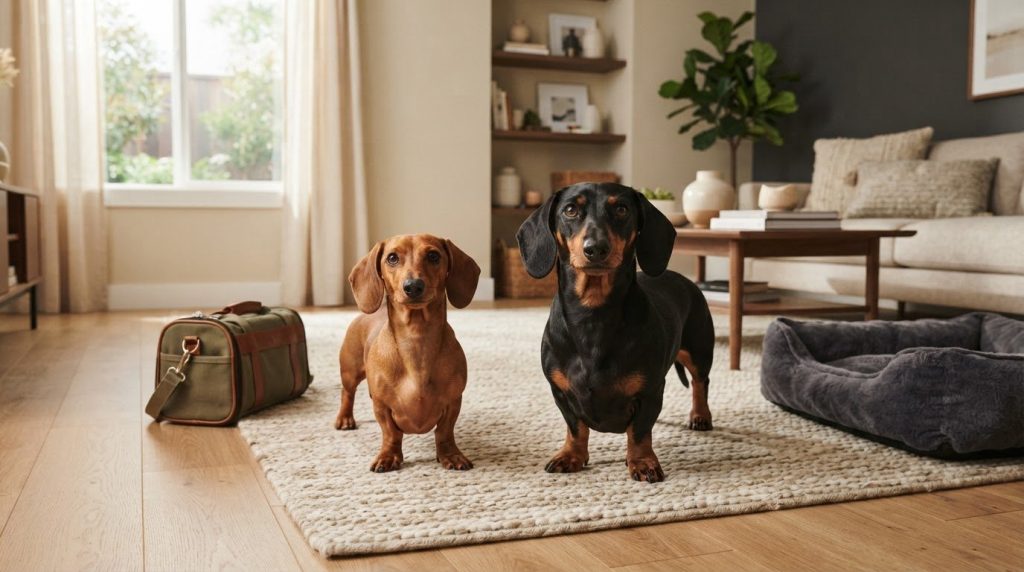
The smaller Dachshund isn’t automatically the easier fit. If you’re weighing miniature dachshund vs standard dachshund, it’s natural to wonder whether a compact companion will suit your home better. But the “miniature” label doesn’t tell the whole story: in the United States, the American Kennel Club classifies Miniatures as 11 pounds or less at 12 months of age or older, while Standards typically weigh 16 to 32 pounds.
Both sizes share the Dachshund’s lively, loyal nature. Either can bring plenty of affection and fun to family life. The right match depends on more than weight: consider your daily routines, how you’ll handle and travel with your dog, and the space and setup at home. This guide explains what U.S. size labels mean, compares adult size and practical household considerations, and offers a straightforward way to weigh your options.
Key Takeaways
- In the United States, AKC size categories are a useful starting point, but they don’t predict a puppy’s adult weight.
- With miniature dachshund vs standard dachshund, the main difference is size classification, not a separate breed identity.
- A smaller dog isn’t automatically easier to care for. Consider handling, travel, and your household’s daily routines.
- Use a simple four-step framework to weigh your size preference, home setup, routines, and the individual puppy’s fit.
- CG Dachshunds offers Dachshund and Miniature Dachshund puppies to approved buyers, with new owners picking up their puppies directly.
Miniature Dachshund vs. Standard Dachshund: What Is the Real Difference?
The main difference is size classification, not a separate breed identity. Miniature and Standard Dachshunds share the breed’s recognizable long-and-low outline, lively presence, and many defining traits. Size can still make a practical difference in daily life. It may affect how comfortably you lift your dog, plan car travel, and manage routine handling as your puppy grows.
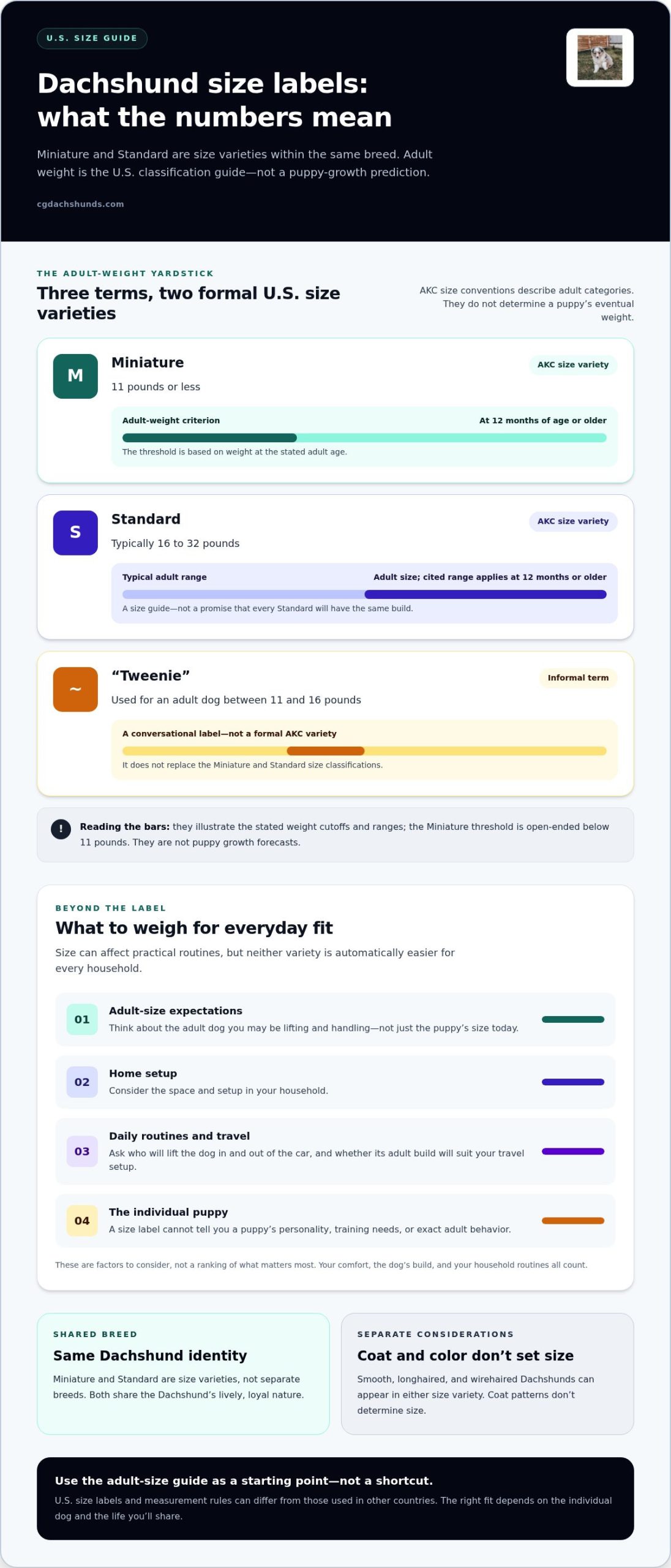
In the United States, this comparison generally follows American Kennel Club (AKC) show-size conventions. The AKC classifies a Miniature Dachshund as weighing 11 pounds or less at 12 months of age or older; Standard Dachshunds typically weigh 16 to 32 pounds. A Miniature Dachshund is an adult Dachshund at or below the AKC’s 11-pound size threshold, while a Standard typically falls between 16 and 32 pounds. These are adult classifications, not puppy-weight predictions.
Size labels and measurement rules differ across countries, so a term used elsewhere may not mean exactly the same thing in the U.S. The Dachshund Wikipedia page offers a broad overview of the breed’s history and variations. This article uses American conventions to keep the comparison clear.
Are Miniature and Standard Dachshunds different breeds?
No. Both are Dachshunds. In U.S. contexts, Miniature and Standard describe size varieties within the breed. Size is separate from coat type and color: smooth, longhaired, and wirehaired Dachshunds can appear in either size variety, and coat patterns don’t determine size. A size label also can’t tell you a puppy’s personality, training needs, or exact adult behavior. Those qualities are individual.
Why compare adult size before choosing a puppy?
A little puppy may be easy to carry now, but its current appearance doesn’t establish whether it will meet the adult Miniature or Standard classification. Adult-size expectations give you a more useful basis for planning than a puppy’s size on one day. They help you picture the dog you’ll be lifting, traveling with, and handling through everyday routines.
Think through practical details at home. Who will lift the dog in and out of the car? Will the dog travel with you, and will its harness or carrier suit its adult build? Is everyone in the household comfortable handling a dog that may be closer to the Standard range? These questions don’t make one variety universally easier. They help you decide which size feels manageable for the people and routines in your home.
The miniature dachshund vs standard dachshund decision is a starting point, not a shortcut to choosing a companion. Consider adult-size expectations, then think about the individual puppy and the life you’ll share. The fit matters more than the label alone.
Miniature and Standard Dachshund Size: How US Classification Works
For a clear miniature dachshund vs standard dachshund comparison in the United States, look at adult weight classifications used by the American Kennel Club (AKC). The AKC’s Dachshund breed information describes Miniatures as weighing 11 pounds or less at 12 months of age or older. Standards typically weigh 16 to 32 pounds. These figures describe adult size categories, not a formula for predicting exactly how much a particular puppy will weigh.
Here’s the distinction at a glance:
| Category | U.S. size criterion | Measurement timing | How to interpret it |
|---|---|---|---|
| Miniature | 11 pounds or less | 12 months of age or older | AKC size variety defined by adult weight |
| Standard | Typically 16 to 32 pounds | Adult size; the cited range applies at 12 months or older | AKC size variety, not a prediction of puppy growth |
| “Tweenie” | Informally, between 11 and 16 pounds | Used to describe an adult dog’s weight | Informal term, not a formal AKC variety |
What size is a Standard Dachshund in the United States?
A Standard Dachshund typically weighs 16 to 32 pounds as an adult. Weight is the practical measure in this comparison. The category isn’t determined by coat type, color, or how tall a puppy looks. Individual dogs can have different builds, so the range is a size guide, not a promise that every Standard will look or feel alike. It also shouldn’t be used to estimate a puppy’s eventual weight from a single weigh-in.
What size is a Miniature Dachshund in the United States?
Under the AKC’s U.S. size convention, a Miniature weighs 11 pounds or less at 12 months of age or older. The criterion is weight, not chest circumference. Because the classification applies at an adult age, a young puppy’s small frame alone can’t establish its eventual size variety. Growth varies between individual dogs, so don’t treat a puppy’s current weight as a guarantee.
You may also hear Dachshunds between 11 and 16 pounds called “tweenies.” It’s a casual owner term for dogs between the commonly used Miniature and Standard ranges, not an official third AKC category. The term can be useful in conversation, but it doesn’t replace the AKC’s size classifications.
Classification rules vary internationally, so a size label used in another country may follow a different measurement system. For U.S. expectations, focus on the AKC weight categories and the age at which they’re assessed. You can also explore Dachshund puppies at CG Dachshunds while considering which adult size may suit your household.
Miniature vs. Standard Dachshund: Everyday Differences to Compare
Size can shape practical parts of life with a Dachshund, but it doesn’t make one variety the easy choice for every home. A Miniature may be simpler for some people to lift or fit into a compact travel setup; a Standard may feel more substantial to handle. Your comfort, the dog’s build, and your routines all matter. Both need attentive care and handling suited to their individual needs.
Use the chart as a starting point, not a promise about how a particular dog will behave or fit into your home.
| Everyday consideration | Miniature Dachshund | Standard Dachshund | Important caveat |
|---|---|---|---|
| Adult size | 11 pounds or less at 12 months or older under AKC criteria | Typically 16 to 32 pounds | These categories don’t predict a puppy’s exact adult size. |
| Handling | May be easier for some people to lift or carry | May require more strength or a different carrying approach | Consider the individual dog and everyone who will handle them. |
| Home routines | Check furniture access and travel equipment as the dog grows | Plan for an adult body that may need more room in a carrier or vehicle | Measure the dog and equipment; labels alone don’t determine fit. |
| Care | Needs consistent, attentive care | Needs consistent, attentive care | Size doesn’t replace individual health guidance. |
How size may affect handling and daily routines
Think through ordinary moments: lifting your dog into a car, helping them onto a safe resting spot, or carrying them when needed. A smaller adult may be more manageable for one household member, while another person may feel comfortable handling either size. Choose a harness that fits the individual dog and reassess as they grow. Furniture access and travel arrangements also depend on the dog’s proportions and your setup.
Both varieties have the Dachshund’s long-backed build, so handle each with care. Don’t assume that a Miniature needs less attention or that a Standard can manage every jump or climb. For advice tailored to your dog, consult your veterinarian. The Dachshund Club of America’s breed information is another useful resource for learning about Dachshund ownership and the breed.
Does size determine personality or care needs?
No size label can tell you whether an individual dog will be sociable, confident, or quick to learn. Those qualities vary from dog to dog, and daily care should reflect the companion in front of you. The miniature dachshund vs standard dachshund choice can help you plan for adult size, but it shouldn’t replace getting to know each puppy or seeking veterinary guidance for health questions.
How to Choose Between a Miniature and Standard Dachshund
There’s no one-size-fits-all answer to the miniature dachshund vs standard dachshund question. A good match comes from looking beyond a puppy’s current size and imagining the adult dog in your everyday life. Use these four steps to turn a broad comparison into a practical, personal choice.
- Clarify your size preference. Think about which adult-size range feels comfortable, rather than choosing based on how tiny or sturdy a puppy looks today. Use the U.S. classifications as a guide, while remembering they don’t guarantee an individual puppy’s adult weight.
- Review your routines. Picture a typical day, including getting in and out of the car, moving through your home, and taking trips together. Consider where the dog will rest and how your travel plans affect the equipment and space you’ll need.
- Consider who will handle the dog. Think about the people who’ll lift, carry, or guide your Dachshund during everyday activities. Everyone’s comfort and ability matter. There’s no need to assume one size is manageable for every household and the other isn’t.
- Get to know each puppy. Consider the puppy’s observed behavior alongside adult-size expectations. Notice how the puppy responds to ordinary interaction, and remember that littermates can grow and develop differently.
Which size better matches your home and routine?
Square footage alone won’t decide the best fit. A smaller home may still work well for a family prepared to meet a dog’s needs, while a larger home doesn’t automatically make one size the right choice. Focus on movement through your space, where your dog will rest, and how you’ll manage transport. Plan for the adult dog you hope to welcome, not just the puppy’s present-day proportions.
How to think about an individual puppy
A size label is useful context, but it can’t tell you everything about the puppy in front of you. Watch how the puppy engages with people and its surroundings, and consider whether that individual feels like a natural fit for your household. Don’t treat a puppy’s label or early appearance as a guarantee of adult size. Keep your expectations flexible as the puppy grows.
Choosing thoughtfully means balancing your preferences with practical plans, then meeting the individual puppy with an open heart. CG Dachshunds offers Dachshund and Miniature Dachshund puppies to approved buyers seeking companion homes. Explore Dachshund puppies at CG Dachshunds as you consider which size and puppy may suit your home.
Explore Miniature and Standard Dachshund Puppies at CG Dachshunds
Choosing between a Miniature and Standard Dachshund is about picturing the adult companion who’ll share your home, not simply picking the puppy who looks smallest today. Both are size varieties within the Dachshund breed. Adult-size criteria can help set expectations, but they can’t promise the exact size an individual puppy will reach. Let your decision reflect your household’s routines, how you’ll travel together, and how comfortable everyone feels handling the dog.
There’s no single right answer for every family or home. Balance the size range you prefer with your real-life setup, then leave room to connect with each puppy as an individual. That’s a steadier foundation for a lasting companion relationship than relying on a label alone.
What to keep in mind as you consider a puppy
Use U.S. size guidance as a reference point, not a guarantee. Consider whether your planned travel arrangements can accommodate the adult dog you expect and whether the people in your home feel at ease with everyday handling as the puppy grows. These practical details can clarify what feels right without turning either size into a universal recommendation.
- Compare adult-size expectations rather than judging only by a puppy’s current appearance.
- Picture how the dog will fit into your home and regular travel routines.
- Think about who will handle the puppy as it grows into adulthood.
- Notice each puppy’s individual behavior as part of the match.
Size is one helpful part of the decision, but it doesn’t define a puppy’s personality or determine how your life together will unfold. Consider the whole picture and the long-term care a companion deserves.
A welcoming next step with CG Dachshunds
CG Dachshunds offers Dachshund and Miniature Dachshund puppies to approved buyers seeking companion homes. As you consider the miniature dachshund vs standard dachshund choice, keep your priorities close: adult-size expectations, household routines, and the individual puppy who feels like a natural fit.
New owners pick up their puppy directly in person. Explore Dachshund and Miniature Dachshund puppies at CG Dachshunds as you consider welcoming a companion into your home.
Take the Next Step Toward Your Dachshund Companion
The best choice is the one you can welcome with care and confidence, not the one that seems to fit an idea of the “perfect” Dachshund. Let your thoughts about miniature dachshund vs standard dachshund guide you toward a companion you’re ready to share everyday life with. Take time to picture the bond you hope to build, from quiet moments at home to the routines you’ll enjoy together.
CG Dachshunds offers Dachshund and Miniature Dachshund puppies to approved buyers. New owners pick up their puppies in person. If you’re ready to take the next step, explore Dachshund and Miniature Dachshund puppies at CG Dachshunds.
Frequently Asked Questions
Can two Dachshund puppies from the same litter grow into different size categories?
Yes, littermates can grow at different rates and finish at different adult sizes. A sibling’s current weight isn’t a reliable stand-in for another puppy’s eventual measurement. Under U.S. AKC criteria, Miniatures are 11 pounds or less at 12 months of age or older, while Standards typically weigh 16 to 32 pounds. Treat puppy-age estimates as guidance and use the applicable adult criteria rather than judging by a sibling’s size.
What does “tweenie” mean when people talk about Dachshunds?
“Tweenie” is an informal term for a Dachshund whose size falls between typical Miniature and Standard expectations. It isn’t a formal third size variety under the U.S. classification discussed here. Since people may use the word casually and differently, it doesn’t replace an official size assessment. If you hear it used for a particular dog, ask what the speaker means rather than assuming it describes a specific measurement.
What happens if a Miniature Dachshund grows beyond the expected size range?
The dog is still a Dachshund and, above all, your companion. An adult’s measured size may not match the expectation suggested when they were a puppy, so rely on the applicable adult criteria rather than an early label. A casual term such as “tweenie” may describe a dog between common size expectations, but it isn’t a formal U.S. category. Don’t change feeding to affect size without guidance from your veterinarian.
Can a Standard Dachshund puppy be smaller than a Miniature Dachshund puppy at the same age?
Yes. Two puppies can differ in growth rate and build, so one may look smaller during a side-by-side comparison even if their expected adult categories differ. A single weigh-in or photo captures only that moment; it can’t reliably establish either puppy’s eventual classification. If you’re comparing puppies, focus on their individual growth over time and use the relevant adult criteria as guidance, not as a promise of a particular outcome.
Is the word “miniature” used the same way for Dachshunds in every country?
No. Kennel-club systems can distinguish Dachshund sizes using different categories or measurements. This article follows U.S. conventions, including the American Kennel Club’s weight criteria for Miniature and Standard Dachshunds. If you’re reading guidance from another country, don’t assume its measurements translate directly to U.S. classifications. Check which organization’s standard is being discussed and how it measures size before applying that information to a puppy or adult dog.
Should I choose a Dachshund based only on its expected adult weight?
No. Expected adult weight is useful for picturing practical details, but it can’t tell you what an individual dog will be like or how naturally they’ll fit into your household. As you consider miniature dachshund vs standard dachshund, think about who will handle the dog, your usual travel plans, and the routines you can comfortably support. Let size inform your decision, not make it for you.