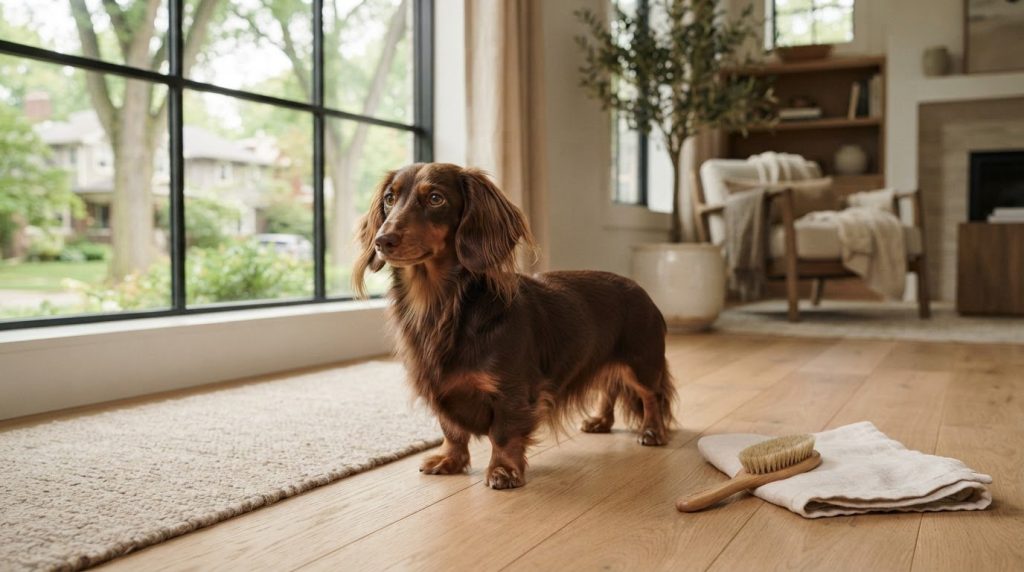
What if the biggest question about a mini long haired dachshund isn’t how small it is, but how its flowing coat fits into your routine? The soft fringes on the ears, legs, and underside are part of the breed’s charm. It’s natural to wonder whether they’ll mean extra work.
That’s worth considering, but coat care doesn’t have to feel mysterious. Regular brushing and early attention to tangles can help keep the hair comfortable to handle, while giving you a chance to get your dog used to gentle grooming.
This guide explains what sets the long-haired variety apart, what coat care involves, and what to consider before making room for a Dachshund in your home. It also looks beyond appearance to daily routines, including exercise and thoughtful care for a long-backed body. By the end, you’ll have a clearer picture of whether this companion could be the right fit for you.
Key Takeaways
- Miniature describes a Dachshund’s size classification, while long-haired refers to its coat type.
- A mini long haired dachshund develops distinctive feathering, though the coat’s growth and appearance can vary from dog to dog.
- Compare long-haired and smooth coats to understand how their appearance and grooming routines differ.
- Build a gentle brushing habit and check feathered areas regularly so you can spot tangles early.
- Consider coat care alongside training, exercise, and lifelong commitment when deciding whether this companion suits your home.
What Makes a Mini Long-Haired Dachshund Distinctive?
A mini long haired dachshund is a miniature Dachshund with a long-haired coat. The name combines two different characteristics: “miniature” describes size, while “long-haired” describes the coat.
Miniature Dachshunds aren’t a separate breed from standard Dachshunds. The American Kennel Club classifies them by size, with its miniature division applying to dogs weighing 11 pounds or less at 12 months of age or older. An individual dog’s adult size can vary, so the label is a classification, not a promise of an exact weight or build.
How the miniature size and long-haired coat fit together
Size and coat are separate characteristics of the same breed. Dachshunds are recognized in standard and miniature size divisions, and their coats may be smooth, long-haired, or wire-haired. This Dachshund breed overview provides more context on the breed’s size and coat varieties.
A long-haired Dachshund isn’t automatically miniature, and a miniature Dachshund doesn’t necessarily have long hair. The descriptions work together when a dog belongs to the miniature size division and has the long-haired coat type. As with any dog, adult proportions and overall appearance can differ between individuals.
What the long-haired coat looks like
The long-haired coat gives the Dachshund’s familiar shape a soft, flowing outline. Breed-standard descriptions characterize the hair as sleek and slightly wavy, with longer feathering around the ears, beneath the neck and body, behind the legs, and along the tail. The feathering is especially noticeable in motion, when the ear fringes and tail hair can sway.
The coat isn’t uniformly long from head to paw. Hair is shorter on parts of the face and body, while the ears, underside, legs, and tail carry more length. This variation creates the coat’s distinctive shape without changing the breed’s short-legged, elongated outline.
Coat texture and fullness vary between dogs, so two long-haired Dachshunds may not look exactly alike. One may have more prominent ear fringes or a fuller tail, while another’s feathering is subtler. These differences are part of individual appearance, not a different size or coat classification. Looking at the whole dog, rather than expecting a single picture-perfect outline, helps set realistic expectations for how a puppy may look as it matures.
How a Mini Long-Haired Dachshund’s Coat Grows and Changes
A puppy’s first coat is only an early glimpse of the adult dog. As a mini long haired dachshund grows, its coat’s length, texture, and feathering may become more noticeable. The pace and final look differ from dog to dog, and there isn’t a reliable age when every puppy’s adult coat appears. Enjoy the changes without treating a calendar as a promise.
What to expect as a puppy matures
A puppy may initially have shorter, less-developed hair in areas that later carry longer feathering. With maturity, you may notice more length around the ears, beneath the body, behind the legs, and on the tail. These changes can happen gradually, and the coat may not develop evenly across every area at once.
Breed-standard descriptions are a useful guide to the mature coat, not a timetable for an individual puppy. The American Kennel Club describes long hair as sleek and glistening, often slightly wavy, with extra length in particular areas. Its Dachshund breed standard information offers a general reference. Puppy photos are snapshots, too. A picture shows how a dog looked at one stage, but it can’t guarantee exactly how the coat will look as an adult.
Why coat changes vary between individual dogs
Even puppies with the same coat type can develop different amounts of length and fullness. One may grow noticeable ear fringes early, while another’s feathering becomes clearer later. Texture and overall outline can vary as well. Focus on the broad long-haired features rather than expecting every dog to match a particular photograph.
Coat growth and coat color or pattern are separate parts of a dog’s appearance. Color may look different as a puppy matures, but that alone doesn’t tell you how long the adult hair will become. For questions about color names and patterns, use a dedicated Dachshund coat-colors guide rather than treating color as a predictor of feathering.
Normal development versus a coat concern
A gradual change in length or texture can be part of growing up. Don’t use coat development to explain away sudden or troubling changes, though. If you notice persistent itching, irritated skin, bald patches, or an abrupt change in the coat, contact your veterinarian for advice. A veterinarian can help determine whether the issue needs attention. That’s different from simply watching a puppy’s feathering emerge.
As your puppy grows, take occasional photos from similar angles and in natural light. They can help you notice gradual changes without turning each week into a test of whether the “finished” coat has arrived. If you’re also exploring life with a Dachshund, learn about CG Dachshunds’ miniature Dachshund puppies as you consider the right companion for your home.
Mini Long-Haired vs. Smooth-Coated Dachshunds: What Changes?
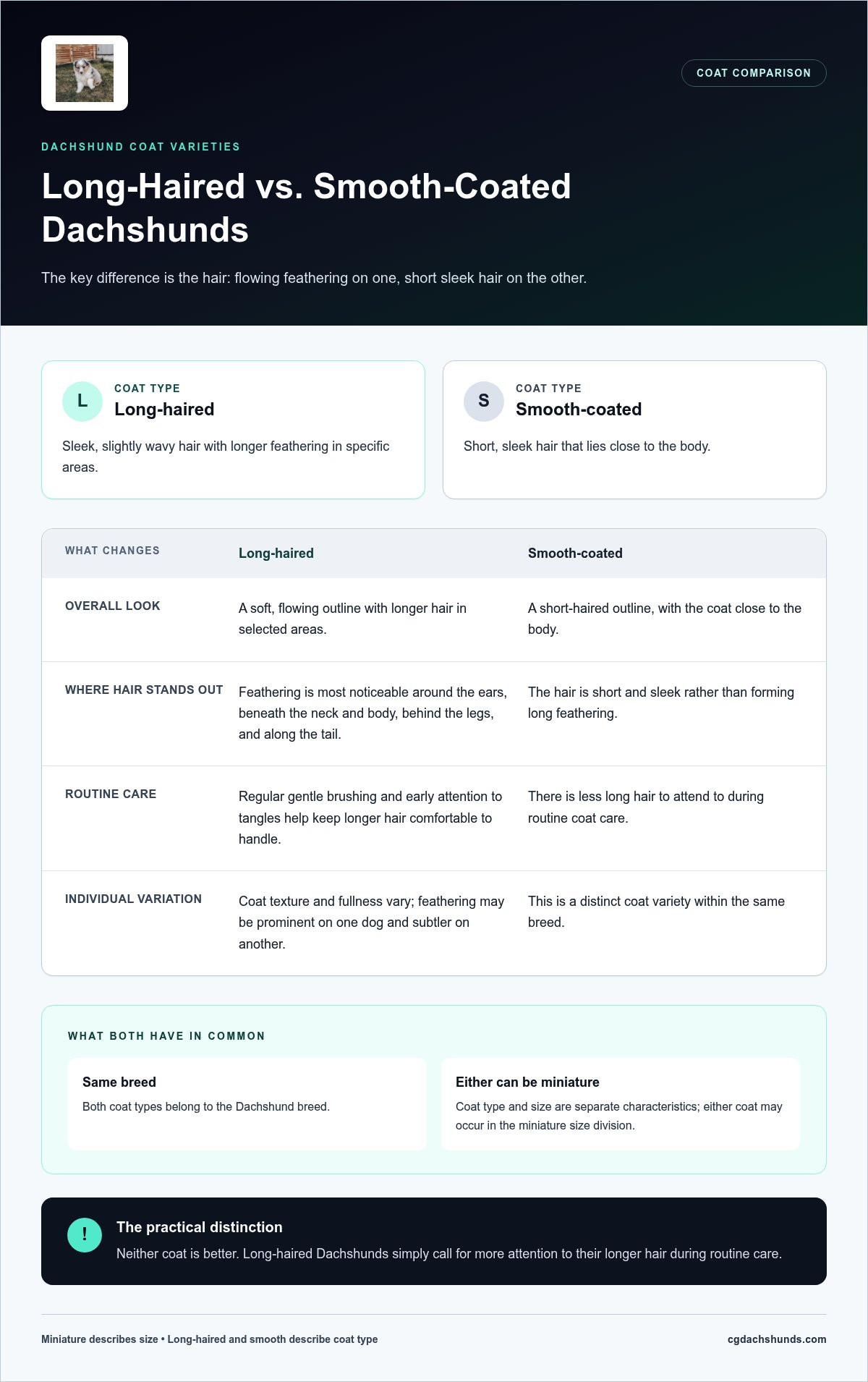
Both coat types belong to the Dachshund breed, and either can be found in the miniature size division. The difference you’ll notice most is the hair itself: one coat has flowing fringes, while the other lies short and close to the body. The American Kennel Club’s Dachshund breed information describes these as distinct coat varieties, each with its own characteristic appearance.
In brief, long-haired Dachshunds have soft feathering around areas such as the ears, underside, legs, and tail, while smooth-coated Dachshunds have short, sleek hair that lies close to the body. Neither is better. The practical difference is how much attention you’ll give to longer hair during routine care.
The visible differences between long-haired and smooth coats
Use this comparison to picture the everyday differences between the coats. Individual coats can vary, but the general distinctions are clear.
| Coat feature | Long-haired | Smooth-coated |
|---|---|---|
| Overall appearance | Longer, sleek hair with a soft, flowing outline | Short, smooth hair that lies close to the body |
| Feathering | Longer fringes may appear on the ears, underside, behind the legs, and tail | No comparable long fringes; the coat looks more uniform and close-fitting |
| Routine coat attention | Brush and check longer areas for loose hair and tangles | Usually simpler to brush, with less long feathering to check |
How coat type can shape grooming habits
Longer hair can catch on itself, especially where it rubs together or against bedding and furniture. For a mini long haired dachshund, gently check behind the ears, under the body, and around the legs and tail. Regular brushing helps you spot small tangles before they become harder to work through. Keep sessions calm and comfortable, and avoid tugging at knots.
A smooth coat has less feathering to detangle, so its routine may feel more straightforward. Still, every dog benefits from gentle handling and coat checks as part of ordinary care. Let your dog’s coat guide the routine: notice how quickly it tangles and what you find during brushing. There’s no need to assume a fixed schedule or a particular amount of shedding based on coat type alone.
Choose with your hands-on routine in mind, not assumptions about personality. If you enjoy slow brushing and don’t mind checking longer fringes, the long-haired coat may suit your preferences. If you’d rather spend less time managing feathering, the smooth coat may feel easier to maintain. Either way, a few relaxed minutes of coat care can become a pleasant part of getting to know your dog.
A Simple Coat-Care Routine for a Mini Long-Haired Dachshund
Coat care can be a calm ritual rather than a big production. A mini long haired dachshund doesn’t need every feather brushed on a rigid schedule. The goal is to keep the coat comfortable, notice tangles early, and make handling feel safe. The American Kennel Club’s Dachshund grooming guidance offers a breed-specific starting point. Your dog’s coat will help you shape a routine that works at home.
Try this gentle sequence, adjusting it to your dog’s coat and comfort:
- Settle in first. Choose a quiet moment and let your dog get comfortable beside you. Keep early sessions brief, speak softly, and offer praise so brushing feels like a friendly part of the day.
- Choose a comfortable tool. A soft brush or comb with smooth, rounded tips may suit longer hair, but let the coat’s condition guide your choice. Use a tool that moves through the hair without scraping the skin or catching and pulling. If your dog flinches or the tool snags, pause and reassess.
- Work through the coat gently. Start with an easy area and brush small sections in the direction the hair lies. Use your fingers to separate a small tangle before carefully working through it. Don’t yank or rush; tough mats can be uncomfortable.
- Check the feathering. Gently look behind the ears, beneath the body, around the legs, and along the tail. These longer areas can rub together or catch debris, so spotting a small knot early makes it easier to address.
- Pause if your dog is distressed. Watch for pulling away, repeated attempts to escape, or signs of discomfort. Stop, give your dog a break, and try again later rather than forcing the session.
Bathing, trimming, and extra help
Bathe your dog occasionally as needed when it gets dirty. Use a shampoo made for dogs, take care around the face and ears, and rinse thoroughly so residue doesn’t remain in the coat. Dry your dog gently and make sure the feathering isn’t left damp or tangled. Keep bathing calm, and ask your veterinarian for advice if your dog has a skin concern.
Some owners prefer a natural, untrimmed outline; others may want to tidy areas that collect dirt. Avoid cutting close to the skin or trying to remove tight mats with scissors. If tangles persist, or coat care feels difficult for you or your dog, a professional groomer can help. Stop and seek veterinary guidance if you notice irritated skin or a sudden coat change.
For many dogs, a quick check during calm handling is more useful than following a one-size-fits-all brushing calendar. If you’re considering a Dachshund, explore CG Dachshunds’ miniature puppy offerings while thinking about the daily care that comes with welcoming a companion.
Is a Mini Long-Haired Dachshund a Good Fit for Your Home?
A mini long haired dachshund may be a lovely match if you’re drawn to the coat and are comfortable making gentle coat checks part of everyday care. Looks are only one piece of the decision, though. Consider the time and attention a dog needs throughout life, including training, exercise, routine care, and companionship, before deciding whether this variety fits your household.
Questions to consider before choosing this coat variety
Picture an ordinary week, not just the happy moment of bringing a puppy home. Could you make room for relaxed brushing and occasional checks after outdoor play? Longer feathering may pick up debris or form tangles, so you’ll need to notice what your dog’s coat needs and respond patiently. A manageable routine matters more than following a perfect schedule.
- Does coat care fit your routine? Consider whether you can make time for calm brushing and gentle handling, even on busy days.
- Are you ready to check after activity? A quick look at longer-haired areas after a walk or play can help you spot a small tangle or something caught in the coat.
- Are you thinking beyond appearance? Include training, suitable exercise, ongoing care, and the commitment of welcoming a dog into your life for years to come.
If your answers feel realistic, the coat may be an enjoyable part of caring for your dog. If you’re unsure, take time to think it through. Choosing thoughtfully is kinder to you and to the dog who’ll depend on you.
Taking the next step with CG Dachshunds
CG Dachshunds sells standard and miniature Dachshund puppies to approved buyers. New owners pick up their puppies directly, as shipping and delivery aren’t offered. Exploring the puppy offerings can help you learn more about the Dachshunds CG raises and consider whether one could be a good fit for your home.
There’s no need to rush into a decision based on coat alone. Think about the everyday care you can comfortably provide, then explore CG Dachshunds’ puppy offerings when you’re ready. A thoughtful match starts with care, patience, and a realistic understanding of the commitment ahead.
Take the Next Step at Your Own Pace
Choosing a dog is about more than falling for a sweet face. Picture the ordinary moments too: making time for care, building trust, and welcoming a new companion into your home for the long haul. If a mini long haired dachshund still feels like a wonderful possibility after considering those everyday needs, you can take the next step with a clear sense of what life together may involve.
CG Dachshunds offers standard and miniature Dachshund puppies directly to approved buyers, with new owners picking up their puppy in person. Explore the puppy offerings and learn more about finding a Dachshund that could be right for your household. A thoughtful decision is a lovely start to a lasting bond.
Explore Dachshund puppies at CG Dachshunds and take a hopeful first step toward welcoming a companion into your life.
Frequently Asked Questions
Are mini long-haired Dachshunds hypoallergenic?
No, mini long-haired Dachshunds aren’t considered hypoallergenic. Dogs can spread allergens through dander, saliva, and other materials, and a longer coat doesn’t eliminate them. If someone in your household has allergies, spend time around dogs before committing and notice how symptoms respond. Regular cleaning of soft furnishings may help reduce loose hair and dander around the home, but it can’t guarantee an allergy-free environment.
How often should a mini long-haired Dachshund be professionally groomed?
There’s no single schedule that suits every dog. Some owners arrange professional grooming around every six to eight weeks, while others adjust based on their dog’s coat condition and the kind of tidying they prefer. Home care between visits still matters, especially if feathering tangles easily. A professional groomer can help maintain the coat comfortably, but persistent skin irritation or sudden coat changes are reasons to seek veterinary advice.
Can you trim a long-haired Dachshund’s coat short?
You can have a long-haired Dachshund’s coat trimmed, but a very short cut may change its natural outline and leave less hair to protect the skin from everyday exposure. If you want a neater look, discuss a modest tidy with a professional groomer rather than cutting close to the skin at home. Explain which areas bother you, such as hair around the feet, and keep your dog’s comfort first.
When does a mini long-haired Dachshund puppy get its adult coat?
There isn’t a dependable age when every puppy’s adult coat arrives. Hair may lengthen and change in texture gradually as the dog matures, and different areas can develop at different rates. A puppy’s current appearance is only a guide, not a precise forecast. If you’re documenting the change, take occasional photos in similar lighting and from the same angle; this makes gradual development easier to notice without expecting a fixed deadline.
Do mini long-haired Dachshunds need special shampoo?
Usually, the key is choosing a shampoo made specifically for dogs, not a product designed for people. Human shampoos can be unsuitable for a dog’s skin. Follow the product directions, keep shampoo away from the eyes, and rinse thoroughly so residue doesn’t remain in the coat. If your dog has itchy or sensitive skin, ask your veterinarian what’s appropriate before trying medicated or specially formulated products.
Can a mini long-haired Dachshund live in an apartment?
Yes, apartment living can work if you can provide daily activity, bathroom breaks, and attention at home. Plan where your dog will rest, play, and go outside, and consider how you’ll manage shared hallways or stairs. Dachshunds have long backs, so limiting repeated jumping on and off furniture and providing a safe way to reach favorite spots can help make the space more comfortable.